
AI strategy
AI Transformation Advisor or Fractional CTO? How to Choose
By Michael P. Goodman · Published · Updated · 8 min read
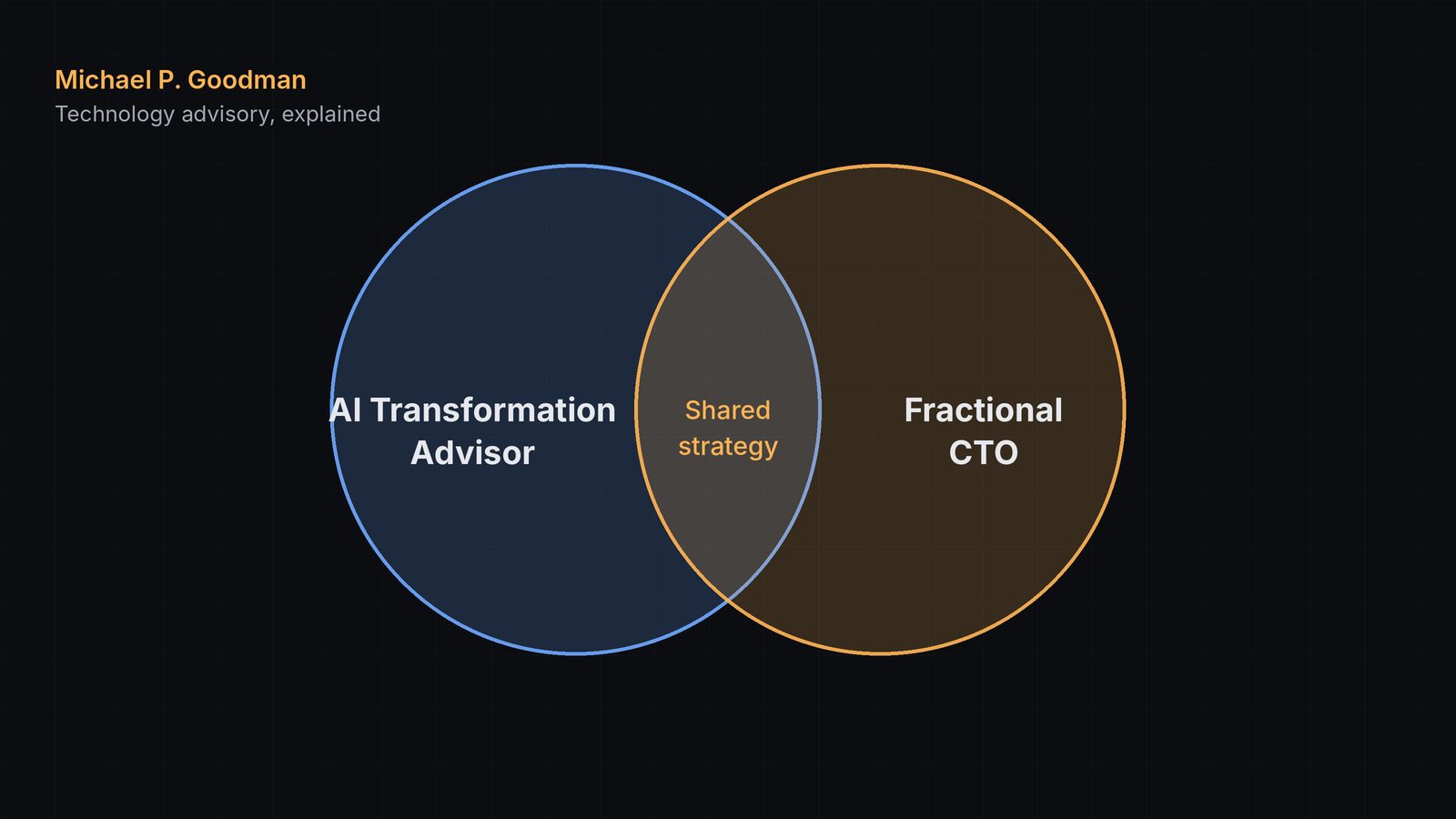
An AI transformation advisor guides a specific initiative, such as picking use cases, setting governance, and designing architecture. A fractional CTO takes ongoing, part-time ownership of your overall technology direction. Choose by asking whether you need a focused project guided or a leadership gap filled.
Leaders ask me some version of this question every week: do we need an AI transformation advisor, a fractional CTO, or both? The titles sound alike, the work overlaps, and the wrong choice wastes months. This guide explains what each role does, where they differ, and how to decide, based on 28 years of running and fixing technology inside real organizations.
Key takeaways: AI advisor vs fractional CTO
- An advisor is project-shaped. A fractional CTO is role-shaped.
- If a strong internal technology leader already exists, you most likely need an advisor, not a fractional CTO.
- If nobody owns technology decisions, an advisor alone will produce a plan that no one executes.
- Governance and data boundaries should be settled before tools are chosen.
- Judge any engagement by whether your team can run the result without the consultant.
What does an AI transformation advisor do?
An AI transformation advisor helps an organization decide where artificial intelligence is worth using and how to adopt it safely. The work is usually scoped around a defined outcome, such as an AI strategy, a pilot, or a modernization roadmap.
Typical responsibilities include:
- Identifying high-value use cases and ruling out low-value ones.
- Assessing data quality, access controls, and risk before any tool is purchased.
- Designing the target architecture, including whether models run locally or in the cloud.
- Defining governance: who approves what, how output is reviewed, and how incidents are handled.
- Guiding a pilot and helping staff adopt the result.
An advisor brings depth on one problem and then steps back. That is a strength when you already have people who can carry the work forward.
What does a fractional CTO do?
A fractional CTO is a part-time chief technology officer. They own technology direction on an ongoing basis, with regular meetings, decision rights, and accountability for outcomes across the whole technology function.
- Setting technology strategy and aligning it with business goals.
- Evaluating vendors and documenting why each choice was made.
- Managing technology budgets and reducing duplicate tools.
- Guiding, hiring, and coaching technical staff.
- Representing technology to the board, investors, and customers.
A practitioner write-up on fractional CTO engagements for AI transformation describes the role as setting architecture, running structured vendor evaluations, and training internal staff to maintain the system afterward. It also warns that drifting into project management or hands-on coding is a common failure. I agree with both points.
AI transformation advisor vs fractional CTO: side by side
| Dimension | AI transformation advisor | Fractional CTO |
|---|---|---|
| Scope | A defined initiative | The whole technology function |
| Duration | Weeks to months, with an end date | Ongoing, usually months to years |
| Decision rights | Recommends | Decides within agreed limits |
| Main output | Strategy, architecture, and a pilot | Direction, vendors, budget, and team |
| Best when | A capable team needs focused expertise | No one owns technology decisions |
Which one does your organization need?
Start with one question: is there already a senior person who owns technology decisions? The answer points to the right engagement.
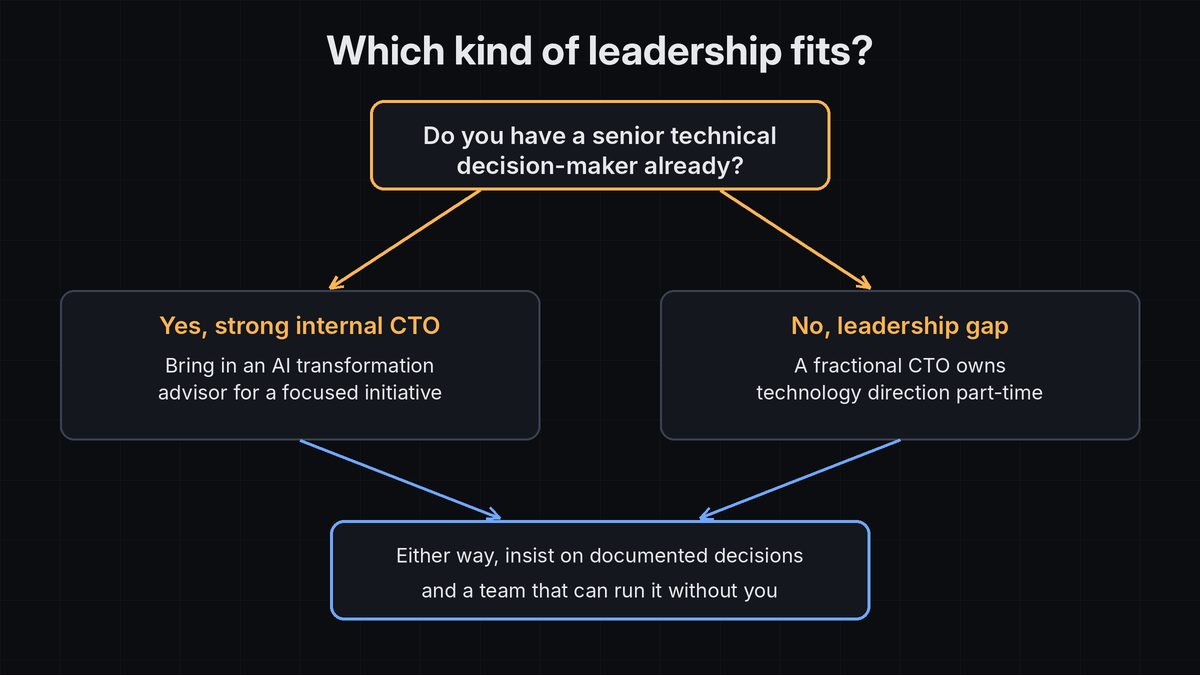
Choose an AI transformation advisor if
- You have a capable CTO, IT director, or lead engineer who will own the result.
- You need expert judgment on one initiative, such as a private AI deployment or an AI policy.
- You want a clear deliverable and end date.
Choose a fractional CTO if
- Nobody senior owns technology, and decisions are made by default or by vendors.
- Spending is scattered across overlapping tools with no single plan.
- AI projects keep stalling because no one has authority to decide.
Consider both if
You need a leadership gap filled today and a specialist initiative running at the same time. The cleanest arrangement is one person owning direction and a separately scoped advisor handling the project, with written decision rights so the two never conflict.
Governance comes before tools
Whichever role you hire, the first work should not be selecting software. It should be deciding what data the AI may touch, who is accountable for its output, and how risk will be measured.
The U.S. National Institute of Standards and Technology published a voluntary AI Risk Management Framework in January 2023, organized around four functions: govern, map, measure, and manage. You can read NIST's announcement in its news release on the AI Risk Management Framework. Using a shared framework gives your advisor, your CTO, and your counsel a common vocabulary and gives auditors something concrete to review.
For law firms, healthcare organizations, and financial institutions, the governance conversation usually ends in the same place: sensitive records must stay under the organization's control. That is the reasoning behind the private architectures I describe in my sovereign IT and AI architecture services and demonstrate in the Project S.P.H.E.R.E. AI infrastructure case study.
What a good engagement leaves behind
The best test of any advisor or fractional CTO is what remains after they leave. A healthy engagement follows a simple arc and ends with your own people in control.
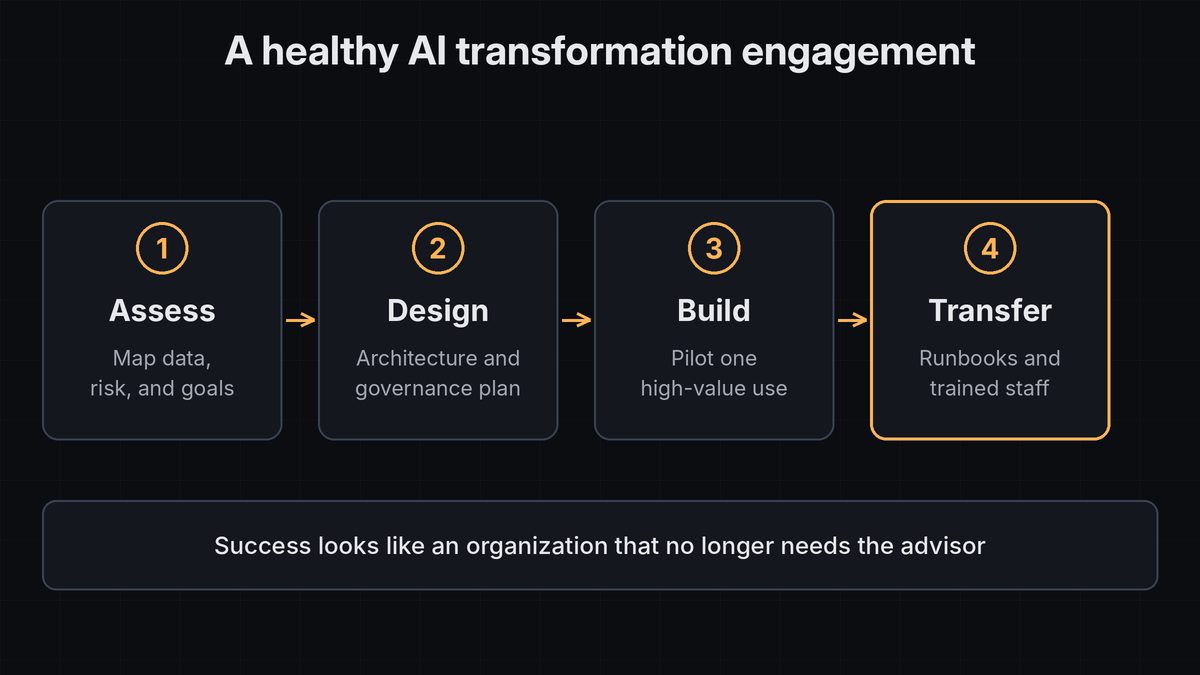
Ask for these outputs in writing before you sign:
- Documented decisions with the reasoning behind each vendor and architecture choice.
- Runbooks your staff can follow without the consultant.
- A governance policy that names owners and review steps.
- Training for the people who will operate the systems.
- A measurable definition of success agreed up front.
How I work with organizations
I am a technology architect with 28 years in IT and more than 20 years as a business owner. I led Computer Service Specialists of New York as president from 2014 to 2024, and my background runs from Windows Server, networking, and virtualization into private AI infrastructure and automation.
I take on focused advisory projects and fractional-style engagements, and I write the difference into the agreement: scope, decision rights, deliverables, and what your team will own at the end. If you want practical examples of the automation side, see my page on IT infrastructure automation, or read more about my background.
AI advisor vs fractional CTO FAQ
What is the difference between an AI transformation advisor and a fractional CTO?
An AI transformation advisor guides a specific initiative, such as choosing use cases, setting governance, and designing the architecture. A fractional CTO takes ongoing, part-time ownership of an organization's overall technology direction, including vendors, budgets, and technical staff.
When does an organization need a fractional CTO?
A fractional CTO makes sense when no senior person owns technology decisions and the organization is not ready for a full-time executive. Common signs include several disconnected tools, unclear technology spending, and AI projects that stall without a decision-maker.
Can one person do both roles?
Yes, many practitioners do, but the scopes should be written separately. A focused advisory project has a defined deliverable and end date. A fractional engagement is an ongoing leadership role with regular cadence and clear decision rights.
How do I keep sensitive data safe during an AI transformation?
Decide early which data may never leave your control, then choose architecture to match. Regulated organizations often run models locally so that no outside AI service processes sensitive records. A governance framework such as NIST's AI RMF helps document those decisions.
Conclusion: AI advisor vs fractional CTO
If you have strong technology leadership and need expertise on one initiative, hire an AI transformation advisor. If no one owns technology direction, a fractional CTO fills that gap and keeps decisions moving. In either case, settle governance first and insist that your own team ends up in control.
Not sure which applies to you? Email me a short description of your situation and I will tell you plainly which model fits, even if the answer is that you do not need me.
Sources: AI advisor vs fractional CTO
- National Institute of Standards and Technology. "NIST AI Risk Management Framework aims to improve trustworthiness of AI." NIST news release, January 2023. Accessed October 18, 2026.
- First AI Movers. "Should You Hire a Fractional CTO to Lead Your AI Transformation?" Accessed October 18, 2026.